





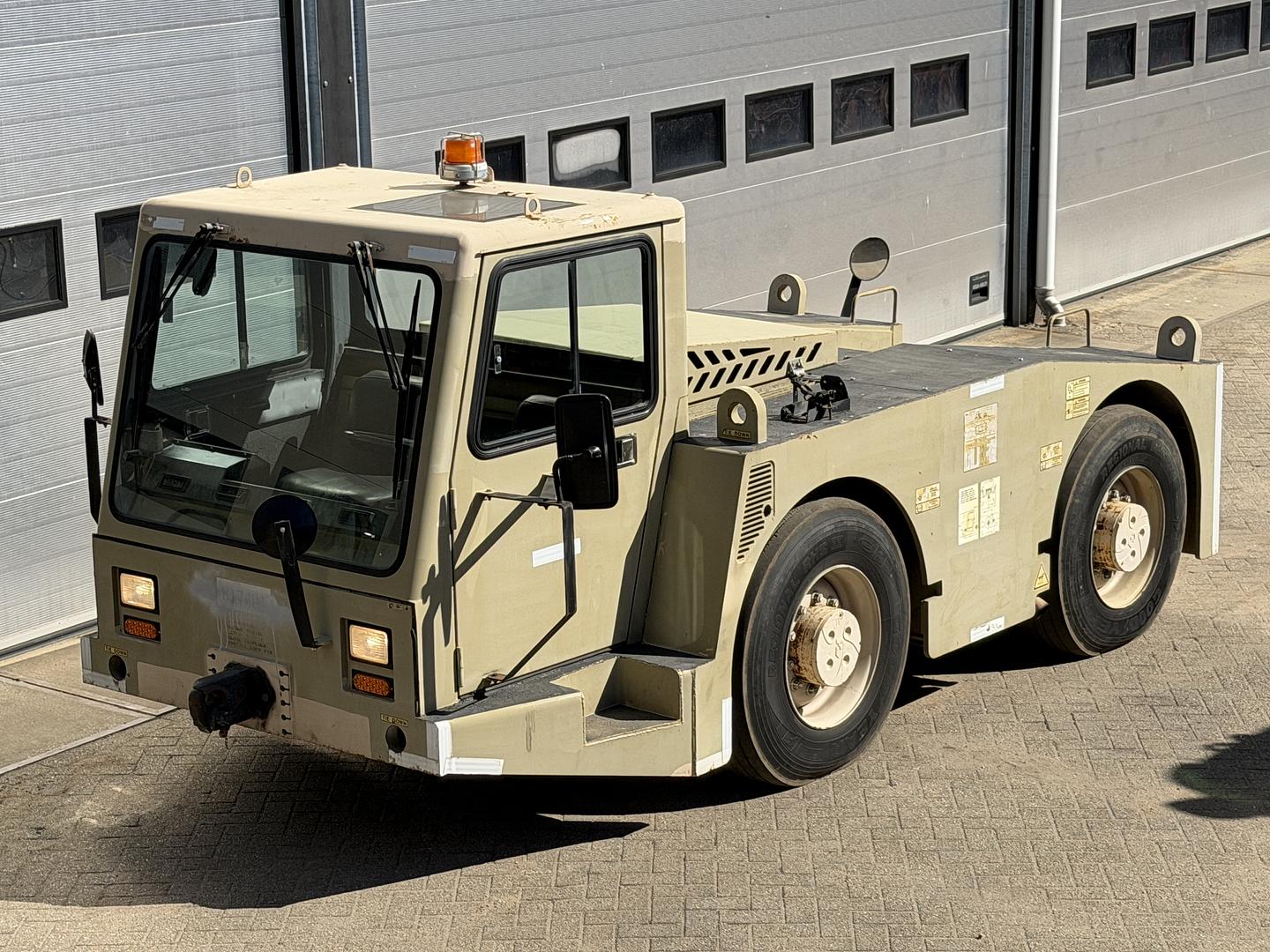
The FMC B450, better known in military circles as the MB-2, is a legendary piece of ground support equipment that has defined flight line operations for decades. While it may appear as a humble tractor, its engineering reflects the rigorous demands of the United States Air Force (USAF).
Here is an informative look at the history, nomenclature, and military heritage of this iconic machine.
Deciphering the Designation: MB-2 Class I
In the world of military logistics, names are never arbitrary. The FMC B450 was standardized under a classification system designed for clarity in high-pressure environments:
- MB: This prefix identifies the vehicle as a motorized, B-series tractor.
- Class I: This signifies its towing power. As a Class I tractor, the MB-2 was engineered to provide a drawbar pull (DBP) typically ranging between 18,000 and 27,000 lbs.
- Military Spec: Unlike civilian models, the USAF version was built with a low-profile silhouette, allowing it to maneuver safely under the fuselages and wings of various aircraft.
Service in the United States Defense
The MB-2 served as the "workhorse" for the USAF and US Navy on strategic bases worldwide. It wasn't built for a single aircraft, but rather as a versatile solution for an entire fleet.
- Diverse Applications: It was the primary choice for moving tactical fighters like the F-15 Eagle and F-16 Fighting Falcon. However, its true power was felt when repositioning heavy transporters, such as the C-130 Hercules or even the C-141 Starlifter.
- Extreme Environments: From the humid tropical bases in the Pacific to the freezing runways of Alaska, the B450 was designed for 24/7 readiness. Its heavy-duty industrial diesel engine and simplified mechanical systems meant it could be repaired quickly in the field.
- Precision Mobility: On crowded flight lines or inside tight hangars, space is a luxury. The B450 featured four-wheel drive and four-wheel steering, enabling a turning radius that allowed it to spin almost on its own axis.
Distinctive Military Features
What sets an "Ex-Army" FMC B450 apart from standard commercial tugs are the specific battlefield modifications:
- Black-out Lighting: Equipped with specialized lighting systems to ensure the vehicle remained nearly invisible from the air during nighttime combat operations.
- Ballasted Chassis: To ensure the tires could grip the tarmac without slipping under heavy loads, the chassis was factory-weighted with heavy steel plating.
- Standardized Couplings: The vehicle utilized universal NATO-spec hitches, ensuring compatibility with any standardized towbar in the military inventory.
A Legacy of "Over-Engineering"
The reason the FMC B450 remains in high demand today—long after its initial military service—is its "over-engineered" construction. In an era where modern equipment relies heavily on sensitive electronics, the B450 relies on brute mechanical force. It is a testament to an era of manufacturing where longevity was the primary requirement, making it a timeless icon of aviation history.